Petra's Dubai Insider Guide: 20 Things I Wish I Knew Before Moving Here
I moved to Dubai from Austria five years ago. Not on a company relocation package. Not with a prepared expat handbook. I chose Dubai, booked my flight, and figured out the rest when I landed. It worked but there are things I know now that would have saved me significant time, money, stress, and embarrassment if someone had simply told me before I arrived.
This is that list. Twenty things that are genuinely useful to know before you arrive in Dubai written from five years of daily life here, not from a press release or a property brochure. Some are practical. Some are cultural. Some are warnings. All of them are things I tell guests personally when they stay with Pera.
The practical things, what to sort in your first week
01. Your first home should not be a hotel
The single most useful thing anyone told me before I moved and I had to learn it anyway that a hotel is a terrible base for your first month in Dubai. It is expensive (AED 600–900 per night for a mid-range room), it gives you no kitchen, no space to unpack, no sense of neighbourhood, and no context for the decisions you need to make: where to live, which area suits your daily life, how long a commute feels in practice.
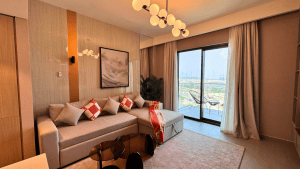
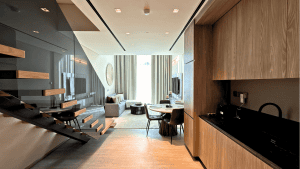
Book a furnished short-term apartment for your first one to three months. You will make better decisions, save significant money, and actually experience Dubai rather than watch it through a hotel window. This is precisely why Pera exists.
Petra’s tip: Book your first month in a furnished apartment before you land. Arriving without accommodation sorted is the most preventable source of first-week stress.
02. Get the SIM card right at the airport
The moment you clear customs, before you do anything else, get a SIM card. Both du and Etisalat (now e&) have counters in the arrivals hall. A prepaid SIM with 10GB data costs approximately AED 150–200. You will need a working UAE phone number before you can register for almost anything like DEWA, the Emirates ID portal, Careem, your bank. Do not assume your European roaming plan will cover you adequately because it will not.
Petra’s tip: Du has slightly better coverage in residential areas like JVC and Meydan. If you are staying in either of those communities, choose du at the airport counter.
03. WhatsApp is not a casual channel here but it is how professional Dubai works
In Germany or Austria, professional communication defaults to email. In Dubai, at every level from government offices to major hotel chains to your building management WhatsApp is the primary professional channel. Messages on WhatsApp are answered faster than emails, taken more seriously than phone calls left in voicemail, and used for everything from rental agreements to medical appointment reminders. Adjust your expectations immediately. If you send a formal email to a Dubai contact and hear nothing back for three days, try WhatsApp. You will likely have a response within the hour. This shift took me longer to make than it should have.
04. The DEWA deposit is not a fee and you get it back
When you connect electricity and water through DEWA (Dubai Electricity and Water Authority), you pay a security deposit of AED 1,000–4,000 depending on the property type. Many first-time residents treat this as a cost of moving. It is not rather it is fully refundable when you close the account. Keep your DEWA account number from day one and the refund is straightforward when you eventually leave or move. I know people who left Dubai without claiming AED 4,000 because they did not know they could.
05. The summer is genuinely extreme so plan around it, not through it
June to September in Dubai is not ‘a bit hot’. It is 40–47 degrees Celsius at midday, with humidity in coastal areas that can make 38 degrees feel like a sauna. Time your move since June to September is intensely hot, the school year starts in autumn, and the pace slows during Ramadan. Long-term residents adapt by shifting their schedule: early morning exercise (before 7am), evening walks after sunset, grocery runs after 9pm, and accepting that some weeks are lived almost entirely indoors or in air-conditioned spaces.
Arriving in summer is not a disaster because I did it but arrive knowing it will colour your first impressions of the city in a way that October or November will completely reverse. Dubai in winter (October to March) is genuinely one of the most pleasant places on earth to be outside.
Money, banking, and admin what actually works
06. Use Wise until your UAE bank account opens
You cannot open a full UAE current account until you have your residence visa and Emirates ID which takes at least two to four weeks from arrival. In the meantime, Wise (formerly TransferWise) is essential for EUR to AED transfers. It uses the real mid-market exchange rate with a 0.4–0.6% fee, versus the 2–4% spread you will pay on a standard bank wire. On a AED 50,000 deposit transfer, that difference is AED 1,700–2,500. Use Wise. Keep it even after your UAE account opens for transfers back to Europe.
Petra’s tip: Send your security deposit via Wise from your European account and you will save a meaningful amount versus your German or Austrian bank’s international transfer rate.
07. Dubai runs on post-dated cheques in ways that feel deeply strange
Annual lease agreements in Dubai are typically paid via post-dated cheques and you hand your landlord four, two, or sometimes one cheque for the full year’s rent at signing. The landlord does not cash them immediately; they deposit them on the agreed dates. Bouncing a cheque in the UAE is a criminal offence, not just a banking issue. This means your rental commitment is more serious than anything a European tenancy agreement implies. Understand what you are signing before you sign it.
This is one more reason to spend your first one to three months in a short-term furnished apartment while you learn the market. Committing AED 100,000+ in post-dated cheques before you know which neighbourhood you actually want to live in is a mistake many European arrivals make and spend months reversing.
08. The cost of living is highly variable, Dubai has three versions of itself
Dubai is not one single lifestyle. The city has budget Dubai, mid-range Dubai, and premium Dubai. Your rent choice and school choice usually decide which Dubai you will experience. A single professional earning AED 15,000–20,000 per month can live very comfortably in JVC or Al Barsha. A family with children in a British curriculum school, a villa in Arabian Ranches, and regular restaurant dining will need AED 35,000–50,000 per month. The range is enormous. Research the specific Dubai you are planning to live in before you commit to a salary or a school.
|
Monthly cost
|
Single professional
|
Family of 4
|
|---|---|---|
|
Accommodation (mid-range area)
|
AED 4,500–7,000
|
AED 8,000–15,000
|
|
Food (mix of cooking + dining out)
|
AED 1,500–3,000
|
AED 4,000–8,000
|
|
Transport (car or taxi)
|
AED 1,000–2,500
|
AED 2,000–4,000
|
|
School fees (private curriculum)
|
N/A
|
AED 3,500–8,000 / month
|
|
Health insurance
|
AED 400–700
|
AED 1,500–3,000
|
|
Approximate total
|
AED 9,000–15,000
|
AED 25,000–45,000+
|
Sources: themiddleeastinsider.com (May 2026), godubai.com (April 2026).
09. Your German driving licence converts directly so no test needed
German, Austrian, and Swiss driving licences can be exchanged for a UAE driving licence without a driving test. Bring your original licence, your Emirates ID, a certified Arabic translation of the licence (from an RTA-approved translation office), an eye test result from an RTA optician, and approximately AED 490 in fees. One visit to an RTA Customer Happiness Centre. Done. This is one of the more pleasant surprises of the German-speaking Dubai experience.
10. Tax in the UAE is not zero but it is close
There is no personal income tax, no capital gains tax, and no inheritance tax in the UAE. Corporate tax was introduced in 2023 at 9% for businesses earning over AED 375,000 per year but for individual employees and investors, the personal tax position remains extremely favourable. VAT at 5% applies to most goods and services. Municipality fees apply on rental income (7% of gross revenue). For German residents accustomed to 42–45% Einkommensteuer, the difference is significant.
Petra’s tip: If you have a German Kapitalgesellschaft with a 1%+ stake, Germany’s Wegzugsbesteuerung exit tax may still apply after you leave. Speak to a Steuerberater before you submit your Abmeldung.
Money, banking, and admin what actually works
11. Dubai is far more tolerant than the headlines suggest
The international media coverage of the UAE frequently emphasises legal restrictions in ways that give European arrivals a distorted picture of daily life. The reality of living in Dubai in 2026 is: alcohol is legal and widely available in licensed restaurants, hotels, and licensed venues; mixed-gender socialising is completely normal in every professional and social context; Western dress is standard in malls, restaurants, offices, and most public spaces. The cultural rules are real like modest dress near mosques, respectful behaviour during Ramadan, no public displays of affection but they are not onerous for the vast majority of European residents.
Dubai is a global city built for mobility. People move here for career growth, international experience, strong infrastructure, and a lifestyle that can feel both modern and safe. Approximately 90% of Dubai’s residents were born outside the UAE. You will not feel like a foreigner in any meaningful day-to-day sense.
12. The social life here is faster and more intense than anywhere I have lived
People are away from their usual social networks. They default to meeting other expats through work, apartment buildings, sports clubs, and a well-developed brunch culture that is basically Dubai’s version of going to the pub. You will meet more people in your first six months in Dubai than you typically would in two years somewhere else. This can feel overwhelming or exhilarating, depending on your personality. It is genuinely true.
The flip side: people leave. Dubai expat social networks are in constant flux. Friends who arrived the same month as you may be in Singapore by year two. Build relationships knowing this and not as a reason not to build them, but as context for appreciating them while they exist.
13. Friday brunch is a genuine cultural institution not just a tourist thing
Dubai Friday brunch is a fixed weekly social event for a significant proportion of the expat population at a several hour-long, usually-inclusive dining experience that runs from 12pm to 4pm on Fridays (the UAE day off equivalent to a European Sunday). It is where deals get made, friendships are maintained, and Dubai residents decompress from the working week. Participating is optional, but understanding it as a social institution makes you less confused when everyone in your new office asks on Thursday afternoon what you are doing for brunch.
14. The best restaurants are not in the hotels
Dubai has world-class hotel dining and some of the best internationally branded restaurants on earth. It also has neighbourhood dining that is better, cheaper, and more interesting and almost entirely invisible to someone who never ventures beyond the obvious. The Sri Lankan rice-and-curry places in Karama. The Lebanese grill in JLT. The Turkish breakfast café in Discovery Gardens that opens at 6am. The Filipino restaurant in International City with a queue every Friday. None of these appear in a hotel concierge recommendation. All of them are excellent. Ask a resident.
Petra’s tip: Ask Petra. Giving guests restaurant recommendations that are not on TripAdvisor is one of her genuine pleasures.
15. The German community in Dubai is larger than you expect
There are an estimated 15,000 German-speaking residents in the UAE — a well-established, active community that is significantly larger and better-networked than most German arrivals expect. The Deutsche Internationale Schule Dubai (DISD) offers the German Abitur and IB programmes. German business councils, cultural organisations, and expat WhatsApp groups connect residents across every industry. You will not struggle to find German-speaking doctors, lawyers, accountants, or peers in Dubai.
Petra’s tip: Ask Petra to connect you with the German expat network in Dubai when you arrive. She has been part of it for five years.
16. The Metro is more useful than most car-owning expats admit
Dubai’s Red and Green Metro lines connect the airport, Downtown, Business Bay, DIFC, Dubai Marina, JBR, and Mall of the Emirates in a clean, punctual, air-conditioned system. A Nol card costs AED 25 (refundable) and individual journeys cost AED 3–8. Most expats who own a car use the Metro far less than they should — mainly because they underestimate it initially. For guests staying in properties near Metro stations, it is a genuinely practical alternative to Careem during peak hours.
The incoming Blue Line with confirmed stations in JVC and other residential communities will significantly expand the network’s residential coverage from 2027 onwards.
17. Ramadan changes the rhythm of the entire city and it is worth experiencing
Ramadan falls on a different calendar date each year and lasts approximately 30 days. During Ramadan, eating, drinking, and smoking in public during daylight hours is prohibited by law for everyone wether it is resident or visitor. Working hours are officially reduced. Many restaurants are closed for lunch service. The pace of the city slows noticeably during the day.
After sunset, Iftar the breaking of the fast transforms the city into one of the most hospitable, generous dining experiences you will encounter anywhere in the world. Invitations to Iftar dinners from Emirati colleagues, business contacts, or neighbours are among the warmest social experiences Dubai offers. Accept them. The pace slows during Ramadan so you can factor this into your schedule.
The things that take longer to understand but matter most
18. Spend your first months in a short-term rental before committing to a lease
Annual leases in Dubai are signed with post-dated cheques. The commitment is real and the financial consequence of breaking a lease mid-year is significant. Making that commitment before you understand the city which neighbourhoods feel right at different times of day, which commute you can sustain, which community has the supermarket you actually want to use on a Tuesday evening and is a common and expensive mistake.
The European arrivals I watch make the best decisions in Dubai are the ones who spend three months in a short-term apartment first. They explore different areas, have their preferences confirmed or contradicted by experience, and sign their annual contract knowing exactly what they are signing up for. The ones who rush into a lease in the first two weeks sometimes spend the next 11 months wishing they had chosen differently.
19. The job market has changed but the network still matters the most
Moving to Dubai in 2026 requires an employer-sponsored work permit, freelance permit, Green Visa, or 10-year Golden Visa</cite>. The route you choose shapes everything: which visa you hold, how long you can stay, what flexibility you have if your employer changes. The job market in Dubai rewards sector expertise, English fluency, and professional networks.
What has not changed is that Dubai still runs heavily on who you know. LinkedIn matters. Attending industry events matters. Being present in person matters far more than in European professional cultures where remote relationships sustain careers. If you are moving to Dubai for professional reasons, build your network here actively from month one and not month six.
20. Dubai is not permanent for most people and that is not a problem
Most people who move to Dubai do not stay forever. Many stay two to five years and move on to another city, back home, or somewhere they discovered while living in Dubai. The people I know who have built the best Dubai lives are the ones who arrived with an open timeframe rather than a fixed plan. They treated it as a chapter, not a destination, and found that in doing so, the chapter became longer and richer than they expected.
I moved here planning to stay two years. Five years later, I have a business, a community, and a life here that I did not anticipate when I landed. Dubai has a way of doing that to people who arrive with their eyes open and a genuine willingness to let the city surprise them.
“The people who get the most from Dubai are the ones who arrive curious rather than certain. The city rewards the people who are willing to discover it rather than confirm what they already thought they knew.” — Petra Radu
One final thing: ask someone who lives here
Every city has knowledge that does not live in any guide and the kind that comes from daily life, professional networks, failed experiments, and genuine curiosity about how a place works. Five years of that knowledge is what Pera offers, alongside the apartment you will stay in.
Whether you are planning your first Dubai trip, a three-month work assignment, or a permanent relocation and whether you end up staying with Pera or not but feel free to message Petra directly with your questions. She responds personally, in English, German, or Serbian, and she will give you an honest answer rather than one designed to sell you something.
Ready to make Dubai your next chapter?
Browse Pera’s furnished apartments in Meydan and JVC the two areas Petra personally recommends for first-time and returning Dubai arrivals. Stays from one week to six months. Personal concierge in English, German, and Serbian. Contact Petra directly to plan your stay.
Keep reading